Work Heating and cooling
Two customers arrive at once. The site serves both.
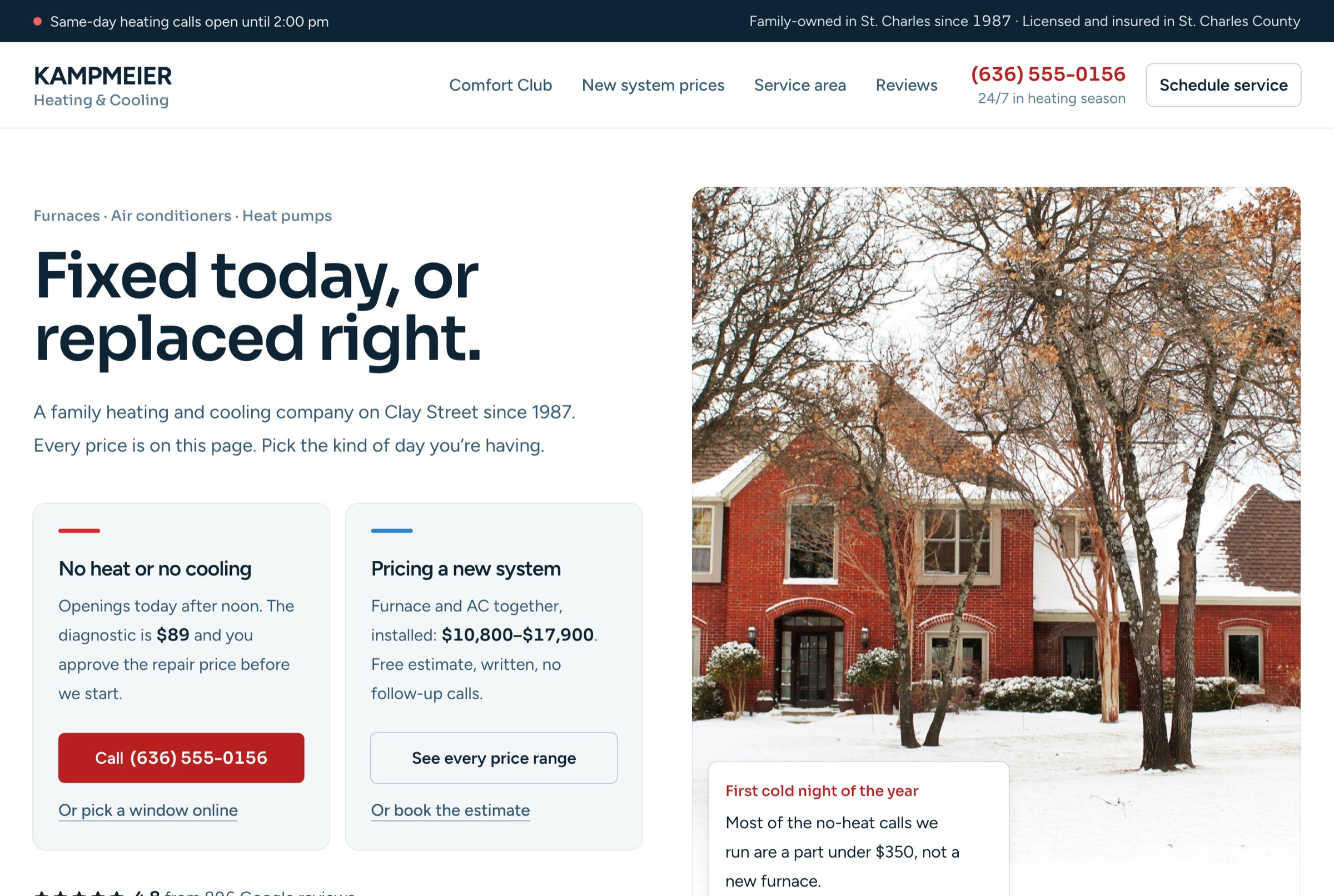
A family-owned heating and cooling company in St. Charles. One visitor has no heat tonight; the next is pricing a $15,000 system. The homepage splits for them in the first screen, and every price is published.
- Trade
- Residential heating and cooling
- Model
- Repairs, a maintenance membership, replacements
- Pages
- Home, membership, a town page, service request
- Form
- Three steps: problem, window, contact
What this business actually sells
Three things, and only two of them pay the bills. Repairs keep the phones busy and the vans moving, but a no-heat call is a few hundred dollars. The money is in replacements, typically $8,000 to $18,000 for a system in St. Charles County, and in the maintenance membership, which is recurring revenue and, quietly, where most of those replacements come from: the technician who has been in the basement twice a year is the one asked to quote the new furnace.
So the website has two jobs on the same page. It has to get a cold, anxious homeowner to the phone in one tap with a price they can trust, and it has to let a careful one compare $11,000 and $17,000 without being made to call first. Most HVAC sites in this market do the first badly and the second not at all.
Decisions, and why
- The hero splits in two
- “No heat or no cooling” with the phone number, today’s availability and the $89 diagnostic, beside “Pricing a new system” with the range for a furnace and AC together. Each visitor sees their own door in the first screen, and neither has to scroll past the other’s pitch.
- Replacement prices, by system
- Five rows, from a furnace alone to dual fuel, each with an installed range and a plain line on when it’s the right choice. A shopper who can see the range books the free estimate; a shopper who can’t calls three other companies first.
- Today’s openings, on the page
- A dispatch board under the hero shows which windows are booked and which are open, and the cut-off for a same-day visit. It answers the emergency caller’s real question, “can you come today,” before they dial. In a real build it reads from the scheduling software.
- The membership shows its checklist
- Twelve items for the fall heating visit, twelve for the spring cooling visit, numbered. “Tune-up” means nothing to a homeowner; a heat exchanger camera inspection and a carbon monoxide reading do. A one-year table shows what $18 a month saves.
- The town page is about houses
- Cottleville is laid out by when the house was built: Old Town, the older subdivisions off Highway N, the 2000s, and the new houses at Cottleville Trails, each with what goes wrong there. It ranks for “furnace repair Cottleville” because it says something only a local company could.
- The form puts the phone first
- Choose “No heat” and a note appears telling anyone in the cold, or with someone vulnerable at home, to call instead. The person who most needs a human shouldn’t be finishing a form. Everyone else picks a problem, a window and a mobile number.
What the site plugs into
A heating company’s demand arrives in two waves a year. The system around the site is built to catch both and to be measured in booked jobs and memberships, not visits.
- Call tracking
- Tracking numbers by source, every call recorded. In this trade most revenue starts on the phone, so a form-only report would miss most of what the site does.
- Google Business Profile
- Hours, after-hours coverage, services and service area match the site exactly. When it’s 9°F, most people pick from the map, not the search results below it.
- Seasonal Google Ads
- “Furnace repair” campaigns turn up with the first freeze forecast and “AC repair” with the first 90-degree week. Replacement searches go to the price table; town searches go to the town page.
- Review requests
- A text after every completed job, and a reply to every review within a day. A fast no-heat rescue at 11pm is the review most likely to get written, so the ask goes out that night.
- Membership and estimate reporting
- Once a month, calls and requests are matched against the job software: memberships sold, estimates booked, replacements closed, and what each cost to get.
- They own all of it
- The domain, the site, the Business Profile, the ad account and the tracking numbers are in the owner’s name from day one. If they leave, everything leaves with them.
A sample monthly report
Illustrative figures for a month like November, the first cold one. The owner sees this, not a chart of impressions.
| Source | Calls and requests | Repair visits | Estimates booked | Memberships sold | Replacements sold |
|---|---|---|---|---|---|
| Google Maps | 142 | 88 | 14 | 21 | 6 |
| Google Ads | 96 | 54 | 11 | 9 | 4 |
| Search, not ads | 47 | 26 | 7 | 6 | 2 |
| Members and repeat | 118 | 71 | 9 | — | 5 |
| Total | 403 | 239 | 41 | 36 | 17 |
Also on the page: Google Ads cost per booked estimate, 22 new Google reviews, every one answered, and the one thing we are changing before the next cold snap.
How it looks, and why that
The category’s default is royal blue and red, a smiling technician in a branded polo, a row of manufacturer logos and a coupon. This goes the other way: a cold frost-white ground, steel-blue ink, and the house in the snow where the stock technician usually stands.
The idea is the thermostat. Archivo, set wide, gives the wordmark and headlines the stance of lettering on a service van. IBM Plex Mono sets everything that can be measured: prices, arrival windows, the numbered checklist. A visitor reads the numbers the way they read a dial.
Ember orange means heat and urgency, and is spent only on the phone number, the one primary button and “no heat.” Glacier blue marks the cooling half of anything that splits by season.
- Type
- Archivo at 118–125% width for headlines and the wordmark, normal width for text. IBM Plex Mono for numbers.
- Color
- Frost #F4F7F8 ground, steel #16242C ink, ember #C2440F, glacier #2F86C9.
- Rhythm
- Max-w-7xl on a 12-column grid. Hairlines between rows; panels only for the two routes, the membership price and reviews.
- Photography
- Houses in the season that breaks things, hands on gauges, an old basement furnace, a van with no logo. A real build adds the company’s own installs and vans.
Run a heating and cooling company?
Send me your website and I will show you where the replacement estimates are leaking out of it.