Work Concept
A pest company sells subscriptions. The site should too.
A family-owned pest control company in St. Peters, up against Orkin and Hawx. The site puts the price in the first screen and turns a visitor into a plan in two steps.
- Trade
- Residential pest control
- Model
- Recurring plan, sold online
- Pages
- Home, plans, a city page, sign-up
- Form
- Two steps, seven fields
What this business actually sells
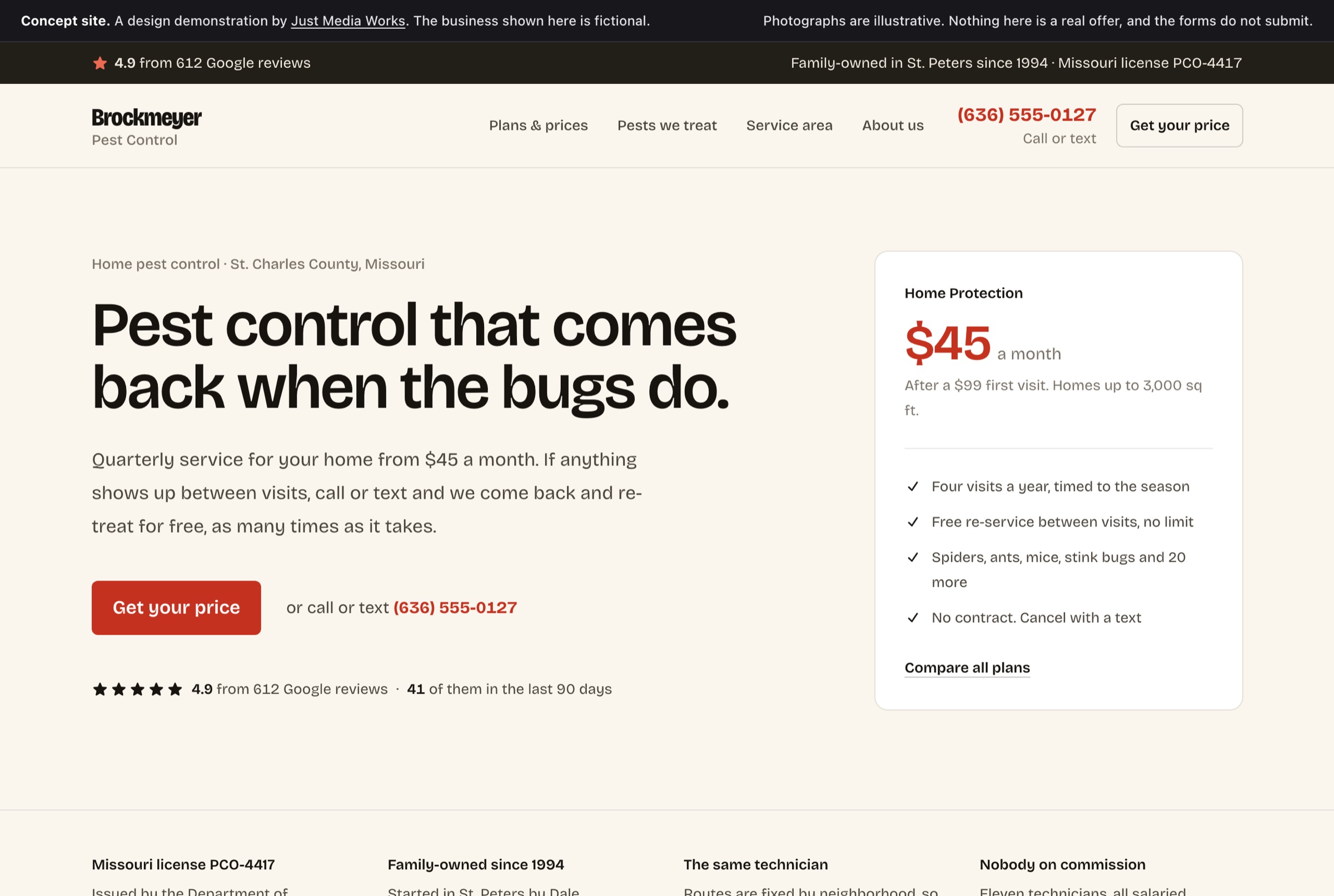
Not a treatment. A plan. A homeowner on a quarterly plan pays every month for years, so one new customer is worth somewhere around a thousand dollars or more over their life, not one ticket. That changes what the website is for: its job is to turn a search for “spiders in basement” into a monthly customer.
The competition is national. Orkin, Hawx and Aptive all sell in St. Charles County, all with large review counts and none with a local owner. A family company cannot win on volume. It can win on a published price, a plain-language guarantee, a name, and a technician who comes back.
Decisions, and why
- Every price is published
- $45 a month, $99 to start, $189 for a single visit, and the range for the jobs that get quoted. Of the local and national pest sites we studied, one published a price. The rest ask for a phone call first, and people who want to compare quietly leave.
- The guarantee names a remedy
- “If they come back, so do we,” then exactly what that means: free, usually within two days, no limit, and a refund after three tries. Everyone in this trade says “satisfaction guaranteed.” Saying what happens is what makes it believable.
- Reviews lead with recency
- 612 reviews cannot beat Hawx’s thousands. “41 in the last 90 days” answers the question a homeowner is really asking, which is whether this company is good now. Most people only read reviews from the last three months.
- The year is the signature
- Four visits, each tied to what is actually coming in St. Charles County: termite swarms in April, boxelder bugs on the south wall in October, recluses in the basement in winter. It explains what $45 a month buys, and a national template cannot write it.
- Sign-up is two steps, not seventeen fields
- Address and plan first, then name, mobile and email. The price updates as the plan changes, with no JavaScript needed for it. One competitor in this market asks for seventeen required fields before anyone gets a quote.
- Each city gets a real page
- The St. Peters page names the roads, the creeks and the housing stock, with reviews from customers there. It is the page that ranks for “pest control St. Peters,” and the one the St. Peters ads point at.
What the site plugs into
A website on its own is a brochure. On a monthly plan, this one is the front end of a system that is measured in booked plans, not visits.
- Call tracking
- The phone number on the page is a tracking number that changes with where the visitor came from: Google Maps, ads, or a search. Every call is recorded, so a junk lead can be disputed and a good one can be traced.
- Google Business Profile
- Hours, services, service area and categories match the site word for word. That consistency is what the map listings check, and the map is still where most local searches end.
- Google Ads landing pages
- Searches for “pest control near me” in St. Peters land on the St. Peters page. Searches for a price land on the plans page. Neither lands on the homepage, which is the most common waste in small-business ads.
- Review requests
- After each visit, the job software sends a text asking for a review, and every review gets a reply within a day. That is what keeps “41 in the last 90 days” true, and it is the input both the map and AI answers read.
- Booked-plan reporting
- Once a month, calls and form requests are matched against new plans in the company’s own routing software. The owner gets one page: plans booked, from where, and what each one cost.
- They own all of it
- The domain, the site, the Business Profile, the ad account and the tracking numbers are in the owner’s name from day one. If they leave, everything leaves with them.
A sample monthly report
Illustrative figures for a month like October. The owner sees this, not a chart of impressions.
| Source | Calls and texts | Online sign-ups | Plans booked | Cost per plan |
|---|---|---|---|---|
| Google Maps | 38 | 9 | 17 | — |
| Google Ads | 24 | 11 | 13 | $108 |
| Search, not ads | 12 | 7 | 8 | — |
| Referral and repeat | 9 | 2 | 6 | — |
| Total | 83 | 29 | 44 | — |
Also on the page: 14 new Google reviews this month, every one answered; 3 junk leads disputed with Google for credit; and the one thing we are changing next month.
How it looks, and why that
The category’s default is a stock photo of a technician in a branded polo, a blue-and-green palette, and a form somewhere near the bottom. This goes the other way: warm paper, black type, and the price where the photo usually is.
Bricolage Grotesque does every job on the page. Its optical-size axis makes the same family read like a shop sign at 60 pixels and like a work order at 16, so the site needs no second typeface and holds together across dozens of city pages.
Barn red is used for exactly three things: the phone number, the main button and the price. Everything a homeowner is looking for is red, and nothing else is.
- Type
- Bricolage Grotesque alone, optical size automatic. Headlines semibold, the wordmark at 85% width.
- Color
- Paper #FAF6EE ground, ink #221E18, barn red #C4321F.
- Rhythm
- Hard-left, max-w-6xl. Hairlines between everything; panels only for the price and the plans.
- Photography
- The pests themselves, so a homeowner can match what they found. A real build adds the owners, the trucks and the technicians.
About this concept
Brockmeyer Pest Control is a fictional business. The name, the people, the phone number, the address and the license number are invented, the reviews and every figure (including the sample report) are illustrative, and every page on the concept site says so. The pest photographs are credited Wikimedia Commons images. It exists to show how this kind of business should sell online, not to represent a client.
Run a service company on plans?
Send me your website and I will show you where the plans are leaking out of it.