Work Concept
A lawn program sells itself when the price and the calendar are public.
Lawn treatment and mosquito control in St. Charles County. A recurring service, so the site's job is to win a season in March and keep it through November.
- Trade
- Lawn treatment and mosquito control
- Model
- Recurring program, six rounds a year
- Pages
- 4, including a city page
- Form
- 5 fields, address first, price shown live
What this business actually is
A lawn treatment company doesn't sell a job. It sells a season — six visits, around $400 for a typical lot — and the customer who stays five years is worth five seasons. Almost every new customer decides between February and April, and the ones who leave usually leave after a brown July or a quiet winter.
A locally owned company here competes with national franchises. We looked at their local pages and at the strongest independents in the St. Louis metro. None publishes a per-application price, and none publishes its round schedule. The best quote flow in the category starts from an address; the rest ask for a call or a visit.
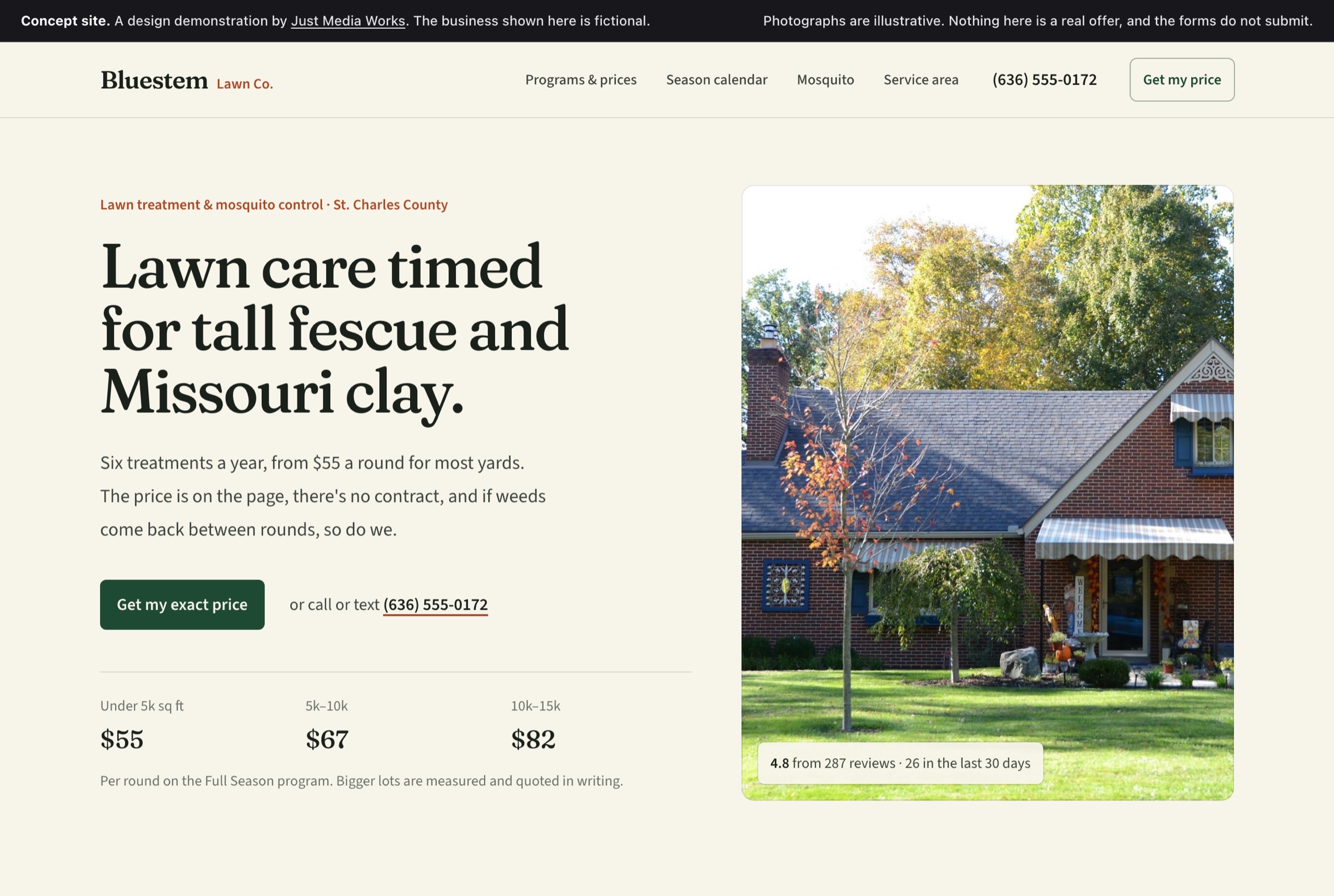
So the site does the two things nobody else will: it puts the price for your lawn size on the first screen, and it shows exactly what goes down and when. Those two facts answer the questions people would otherwise call to ask, and the site doesn't need much else.
Decisions, and why
- Prices per round, by lawn size, on the first screen
- Three numbers under the call to action. The full table, all three programs and every add-on is one click away. A published price binds the company to it, and that is exactly why a homeowner believes it.
- The season calendar is the signature
- Six rounds laid out across March to November, with aeration and mosquito on their own rows. It turns an invisible service into something a homeowner can see, and it does the selling for the September aeration upgrade months ahead.
- Address first, price shown as you choose
- Five fields. The price updates as you pick a size and program, using the same numbers as the programs page. The phone number comes last, and the page promises one text, not a sales call.
- The guarantee names the remedy
- A free return visit, then a refund of that round. That is what the category's guarantees actually say in their fine print; this one says it in the headline.
- The summer round explains itself
- No heavy fertilizer in July, and the site says why. Telling people in advance why the lawn may look tired in August is the cheapest retention there is.
- A city page that is only true of that city
- The Wentzville page is about new-construction lawns on clay fill, the roads people live off, nutsedge in the swales and HOA letters. Swap in another town's name and it stops being true, which is the test a city page has to pass.
The marketing it plugs into
A site like this is the storefront. What fills it is a year that follows the same calendar as the lawn: spend when people are deciding, ask for reviews when the work is fresh, and keep customers through the months they'd otherwise drift.
| When | Google Ads | Business Profile | Reviews and retention |
|---|---|---|---|
| Jan–Feb | Brand terms only | “Next season's prices are out” | Prepay offer to last year's customers |
| Mar–Apr | Peak: lawn care, crabgrass prevention, fertilization | Weekly posts with route photos | Review request after round 1 |
| May–Jun | Mosquito campaign starts | Mosquito plan as a product | Mosquito offer to lawn customers |
| Jul–Aug | Lawn spend at its lowest; brown-lawn questions | Heat and watering advice | “Why your lawn looks tired” text |
| Sep | Second peak: aeration and overseeding | Before-and-after from real lawns | Aeration upgrade to Full Season customers |
| Oct–Dec | Paused for new programs | Season wrap-up | Review request after round 6; soil tests out |
What gets reported
One page a month, in the owner's language: programs booked, what each one cost to win, and who left and why. Matched against the company's own scheduling software, not a dashboard of impressions. The numbers here are illustrative.
| Quote requests | 64 |
| Programs booked | 41 |
| Ad spend | $1,850 |
| Cost per booked program | $45 |
| First-season value of those programs | $16,500 |
| New reviews | 18 |
| Cancellations, with reasons | 3 |
How it looks, and why that
Every lawn company in the county is a green sans-serif page with a stock lawn on it. This one reads more like a seed catalog or an almanac — a soft serif for headlines, a plain humanist sans for the working text, and a straw-colored ground instead of white.
The second color is red clay, the soil every lawn here is actually growing in. It marks the eyebrows, the add-ons and the phone number, so the green is left to do one job: the button that gets you a price.
Prices sit in tables because they're numbers people compare. The calendar is the one designed component; everything else is rules and whitespace.
- Type
- Fraunces for headlines, softened. Source Sans 3 for everything else.
- Color
- Straw #F7F4EA ground, loam #1A211B ink, sod #1E4A33, clay #A94A24.
- Rhythm
- max-w-6xl, editorial splits, hairline rules. Panels only for the calendar, the program cards and the quote form.
- What the category does
- Bright green, a stock lawn photo, “call for a free estimate”, and no price anywhere.
About this concept
Bluestem Lawn Co. is a fictional business. The name, owners, phone number, address and license number are invented. The prices are plausible for this market, and the reviews and report figures are illustrative. Every page on the concept site says so. The photographs are stock images credited in the project; on a real build they would be the client's own lawns and trucks.
Run a recurring service? Your site should sell the season.
Tell me about the business. I'll show you what I'd change first, and what it would cost.